
April is when the racing calendar makes sense again in the southern states. The long weekend cluster around Easter gives way to the autumn schedule — mornings that are cool enough to actually feel your effort, afternoons that have stopped trying to kill you. In Victoria and Tasmania, the best conditions of the year arrive roughly now and stay until June. In South Australia, the Adelaide Hills are at their most hospitable: the dust settles, the temperature drops to something that rewards sustained effort rather than requiring you to ration it. In central Queensland, the dry season is establishing itself after the monsoonal humidity of February and March.
It's a month that rewards runners who were disciplined enough to train through the heat without the performance to show for it yet. April races are where that banked fitness starts to pay out. The distance of your choice tends to land better in these conditions than it did in January or February — the pacing arithmetic is simpler when sweat isn't your primary variable, and you can run by feel again rather than by a heart rate monitor telling you to slow down every third kilometre.
This month's selection runs from an inaugural trail festival on newly laid tracks in Victoria's Wimmera to volcanic rock outcrops in central Queensland's Minerva Hills National Park. In between: Hobart's foreshore marathon on the banks of the Derwent, a Sydney Harbour swimrun that tests a format most Australian runners have never attempted, and the Adelaide Hills at their autumn best. If you're planning around a goal race later in the year — Gold Coast in July, Melbourne in October — April is also a useful B-race window: close enough to give you honest fitness data, far enough out that you're not burning training you'll need later.
A New Festival Built on Trails That Didn't Exist Two Years Ago
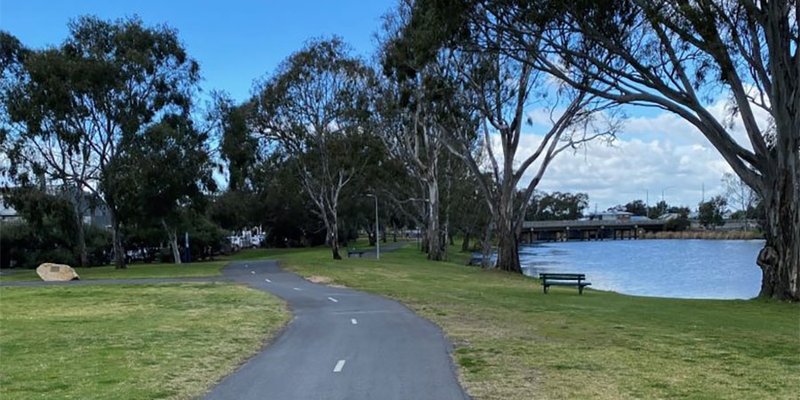
Dimboola sits in the Wimmera, the flat wheat and grain belt of western Victoria about three hours from Melbourne. The town — population around 1,600 — has the bones of a classic Victorian country settlement: a main street with a bakery, a pub, a heritage streetscape, and the Wimmera River running quietly through it. What it also has now, as of this event's inaugural edition, is a 7-kilometre stretch of purpose-built trail linking Dimboola with the Lochiel Rest Area. These tracks are new. They didn't exist in their current form two years ago.
The Dimboola Dash is the first edition of what the organisers are positioning as a proper trail running festival. The marathon format is three out-and-back laps of the 7km riverbank stretch, which means you'll cover each section six times. The half marathon does three laps; the 5km and 10km use the same tracks but let you off considerably sooner. Out-and-backs on repeat are either a feature or a deterrent depending on your disposition — what they reliably provide is a completely even course, no navigational uncertainty, and regular contact with other runners across all distances. In a first-year event on unfamiliar terrain, that's not a small thing.
The riverbank here runs through riparian gum woodland — river red gums and black box over a grassed understorey, with the Wimmera curving alongside. It's not dramatic terrain; the Wimmera doesn't go in for drama. What it offers is a particular kind of flat, shaded, creek-country running that Melbourne's trail scene doesn't easily replicate. The autumn light through river gums in April is the kind of thing that makes you want to be somewhere other than a suburban park.
Dimboola the town has recently gained a reputation for things visitors don't expect. The official event description name-checks the Imaginarium — a local arts and creativity venue that has grown into something of an anchor for the town's cultural life. The suggestion, implicit in how the organisers have framed the event, is that this is a weekend in a place worth visiting, not just a race to get through and drive home from. For road runners who want trail experience without technical terrain: this course is unlikely to challenge your technical running. For trail runners used to significant elevation: Dimboola is flat and you should know that. For anyone who wants an April marathon in conditions that are finally cooperative: this is a well-timed first edition of something that looks set to grow.
A Course That Makes You Pass the Finish Line Before You're Done
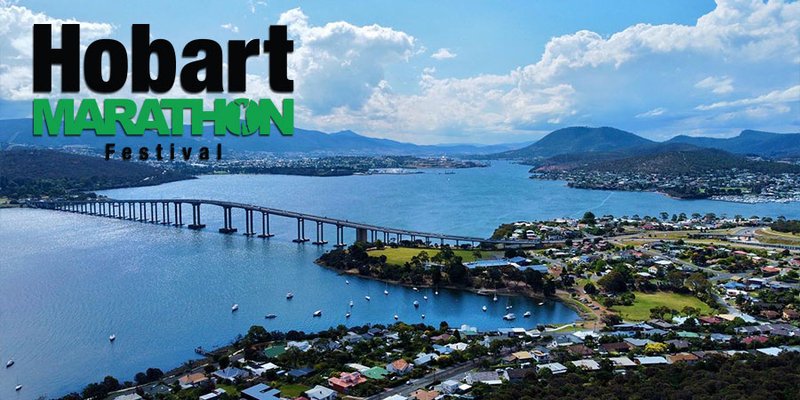
The Hobart Marathon starts and finishes at Constitution Dock — the same dock where the Sydney to Hobart yachts come in after the Bass Strait crossing. There's a specificity to that location that the race makes use of without overstating it. The course runs along the Derwent River foreshore and past the Salamanca Wharves, through one of Australia's more intact colonial-era port precincts, on a 2-lap format that means you'll pass the finish area at the halfway mark and have to keep running. That moment — seeing the finish arch and continuing past it — is the psychological centre of every multi-lap marathon. Hobart doesn't try to hide it from you.
April 12 in Hobart is reliably good conditions for a marathon. Average temperatures of 8–16°C, low humidity, air that's clean in a way that coastal island air tends to be. Tasmania's autumn is cooler than Melbourne's equivalent and less likely to spring a warm-weather surprise — the island's thermal buffering gives race day weather a predictability that continental marathons don't always provide. The course is flat enough to be considered honest without being engineered around a record chase. The harbour foreshore and Salamanca district give you something to look at when the effort becomes repetitive, which it will around the 30km mark on the second lap.
The field size is smaller than Melbourne or Sydney, which has practical implications for the first few kilometres. You're unlikely to spend 10km waiting for the pack to thin out enough to find your pace. Hobart's marathon has grown steadily since its establishment rather than scaling aggressively for numbers, which tends to produce an event character that's more about the experience of running the city than about managing a crowd.
For first-time marathon runners: the 2-lap course means you know exactly what the second half holds before you run it. That knowledge cuts both ways — it removes uncertainty, which helps some people, and provides a clear view of how much is left, which discourages others. For experienced marathoners using this as a stepping stone toward a goal race later in the year: the flat foreshore course and reliable conditions make it suitable for an honest time trial. Hobart on a long weekend in April is also simply a good place to be, which is a factor that doesn't show up in race databases but does influence whether you have a good weekend.
Running in Your Wetsuit, Swimming in Your Shoes
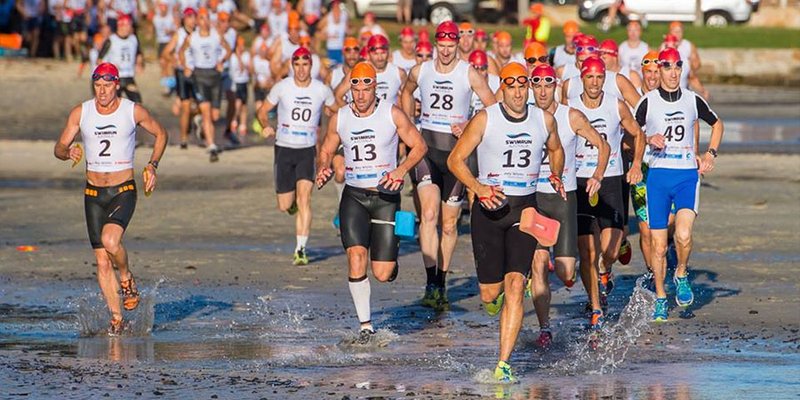
Swimrun arrived in Australia in 2016 and has maintained a committed following without ever breaking into mainstream awareness. The format is simple to describe and genuinely unusual in practice: alternating open water swims and trail runs, completed as a pair, with no transitions between the two disciplines. You run in whatever you're going to swim in. You swim in the shoes you ran in. Everything you need comes with you from start to finish — no gear left on shore, no moment to step back and reset before the next discipline begins.
The Sydney East edition starts from Rose Bay and uses the inner harbour foreshore, taking in the Opera House and Harbour Bridge as backdrop and South Head as a turning point. The practical reality of this course is that you're moving through one of the most photographed coastlines in the world while also being wet, carrying hand paddles, and trying to maintain your team's rhythm through each swim-to-run transition. It is an odd combination of beauty and operational difficulty, which is roughly what makes swimrun different from just doing a triathlon without a bike.
The pairs format is traditional, carried over from the Swedish origins of the sport. You and your partner must remain within a specified distance throughout the race — close enough that the event is genuinely collaborative rather than two individuals who happen to share an entry. This creates a selection pressure that most multisport formats don't have: a swimrun team is only as fast as the arrangement it can negotiate. If one partner is a significantly stronger swimmer, that surfaces immediately and repeatedly. If one is faster on the trails, same. Swimrun selects for honest partnership, or for pairs who've learned to compensate for each other's gaps.
For triathletes who find the transition element of their sport administrative rather than athletic, swimrun removes it entirely — the disciplines blur rather than segment. For trail runners with open water swimming experience, it's a direct translation of existing skills into a different frame. April in Sydney Harbour puts the water temperature at around 21°C — cold enough to be taken seriously, not cold enough to dominate the conversation. The event has been running for a decade and knows what it is. If you've ever looked at the format and thought it might suit you, the Sydney East edition is the entry point.
Five Climbs Across Adelaide's Autumn Hills
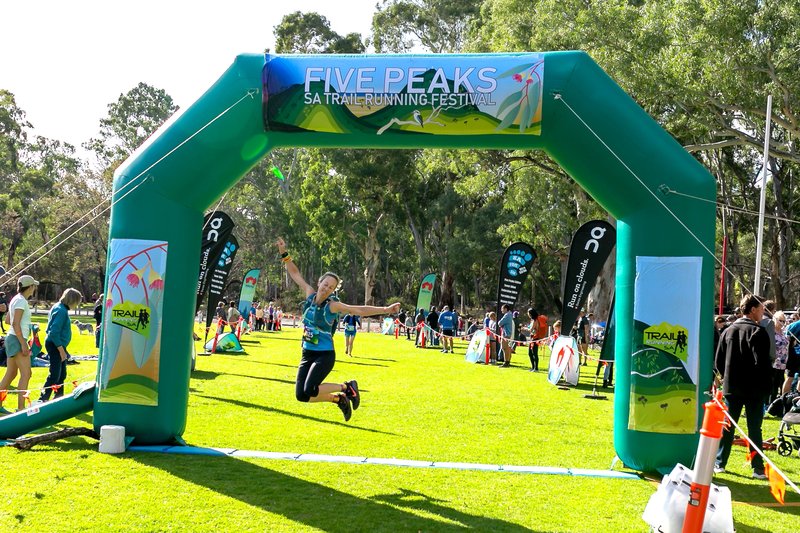
Five Peaks SA does exactly what the name describes: you summit five peaks in the Adelaide Hills across a network of conservation parks southeast of the city — Belair, Cleland, Morialta and the connecting ridgelines. The distances run from 10km to a 58km ultra, and the amount of climbing you're committing to varies accordingly. The 58km covers all five peaks in a single effort; shorter distances take subsets of the route. What the race doesn't do is go easy on the terrain regardless of which distance you choose.
Late April is probably the best possible time to run the Adelaide Hills trail network. South Australia's summer heat breaks reasonably decisively by the end of March, and by mid-April the Hills are several degrees cooler than the city. The trails have had the first autumn rain to settle the summer dust without yet becoming the mud of winter. The native mallee and eucalypt bush on the western slopes of the Hills — which is what you're running through on most of the course — holds its colour well into winter, and the views back toward Adelaide and the Gulf St Vincent on a clear April day are the kind of thing that makes you glad you chose the longer distance.
Trail running in South Australia has a smaller and more concentrated community than Victoria or Queensland, which gives events like Five Peaks a specific character. You're likely to encounter a higher proportion of local runners who know these trails well — the conservation park network here has been used by Adelaide's trail running community for decades, and the race uses existing infrastructure rather than cutting new track. For navigation on the longer distances, that familiarity in the field is useful context.
For South Australian runners looking for an autumn objective that tests real climbing: the 58km is a serious day out on the hills. For interstate runners combining a long weekend: Adelaide Hills accommodation is less pressured than most capital city equivalents and the region has enough to justify the trip independently of the race. For runners considering the 10km or 17km as an introduction to the Hills trail network: this is a more interesting initiation than a park run loop, with enough elevation to teach you something about your climbing and descending before you commit to the longer options.
A Rocky Outcrop in the Flat Centre of Queensland
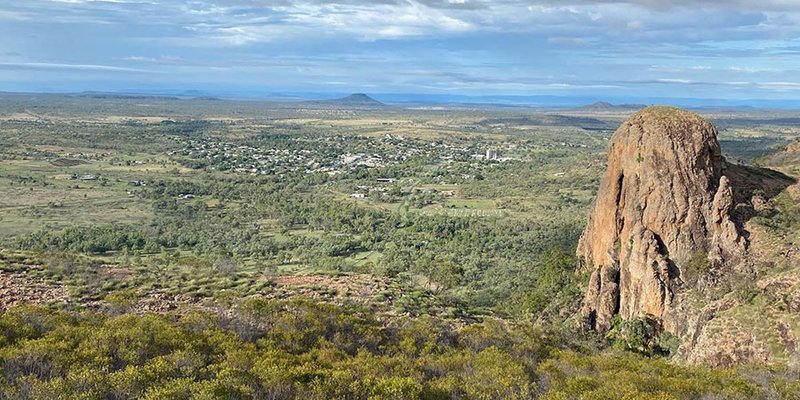
Springsure is a town of about 900 people in Queensland's Central Highlands, roughly 900km northwest of Brisbane and 60km south of Emerald. The surrounding country is flat — rolling cattle and cropping land out to every horizon. Into this landscape, Minerva Hills National Park rises without warning: a series of volcanic rock outcrops and table mountains that have no business being there given the topography around them. The contrast is real and immediate. You arrive through flat country and find something that looks like it was placed there from somewhere else.
The Springsure Mountain Challenge has been running on Mother's Day weekend for well over a decade. It exists as a community fundraiser — the proceeds go to essential rural services in the Central Highlands region, the kind of infrastructure that towns of 900 people depend on. That embedded purpose gives the event a stability that commercial trail races don't always have: it runs because the community needs it to run, not because the market supports it. Visiting runners are welcomed in the way that towns welcome people who've come to help rather than people who've come to be entertained.
The course goes into Minerva Hills National Park proper — through the basalt and sandstone outcrops, with views back over the flat cattle country that puts the elevation into context. The 32km is the flagship distance; the 17km gives you the character of the route without the full commitment. The 10km and 5km stay lower but still take you into the park itself rather than around its perimeter. Distances of 1.6km for children and families round out the morning, which tells you something about what kind of event this is.
May in central Queensland is the dry season at its most settled. Temperatures at Springsure in May average highs around 25°C and lows of 8°C — warm days, cold nights, negligible humidity. Trail conditions in Minerva Hills in May are typically firm and clear. This is the version of Queensland that Queensland runners spend summer wanting. For anyone willing to drive to Springsure from the coast or the ranges: the run itself repays the journey, and the landscape is one of the more distinctive in the state's running calendar. The rocks don't care what you've entered elsewhere this year.
The events above share something that April racing tends to produce: they're worth doing on their own terms rather than as rehearsal for something else. Dimboola is the first edition of a festival that may run for decades. The Hobart Marathon is an established event that has resisted the pressure to become something larger than it needs to be. Sydney Harbour swimrun is a decade-old format that has never gone mainstream and shows no sign of wanting to. Five Peaks and Springsure both exist because their communities made them exist, and keep going for the same reason.
Autumn racing in Australia has a particular register — less pressure than the spring goal-race season, more honesty about what you're there for. Most people who enter in April chose these events because something about them was interesting or convenient or both. That's usually enough of a reason. Not every race needs to be the one you've been building toward. Sometimes the ones that weren't planned that way are the ones worth remembering.